Automating with a robot, without weeks of lost production
You want to expand an existing machine, for example with a robot that automatically unloads products. The benefits are clear: less manual work, and a machine that can run largely unmanned. Yet many companies hesitate, and that's understandable. That machine drives your production. Every day it stands still for a conversion costs money.
So the question isn't just whether you automate, but also how you do it without your production grinding to a halt for weeks.
The principle: testing at our site, not yours
Van Dulst's approach starts from one principle: the customer's machine should be down for as short a time as possible. That's why the entire robot installation, along with a simulation of the existing machine, is first built and tested in our own facility.
Only when everything runs perfectly there does the installation go to the customer. On-site implementation then takes around one week.
In our facility, we replicate the relevant part of your machine and test with real products: profiles that have been processed on your own machine beforehand. That way, all teething problems, adjustments and surprises come to light while your production simply continues.
Step 1: eliminating uncertainties first
With a complex expansion, not everything is known in advance. That's why Van Dulst often works in two phases on custom projects.
In the first phase, an engineering assignment, the critical components are tested and mapped out. For a robot system that removes products, this includes the type of gripper and the gripping force, which are decisive for the entire system. The robot's movements are also simulated in advance.
In this phase, things sometimes turn out differently than expected. That's exactly why it's good that this happens at the drawing board and in the test setup, rather than on the customer's shop floor.
Step 2: the connection to the existing machine
Placing a robot next to a machine is one thing. Getting it to work together with that machine is another. The robot needs to know exactly when it can take action, and the machine needs to know when it can continue.
This connection to the existing control system is often underestimated. So when planning an expansion, don't just look at the robot, but above all at how it will communicate with what's already there. If the machine runs on a Van Dulst control system, the connection is considerably simpler. After all, nobody knows that control system better than Van Dulst.
In practice: robotic unloading at a sawing machine
A customer in the aluminium processing industry, who has worked with Van Dulst for more than twenty years, wanted to automate the unloading of products at a sawing machine. The short products were sawn in high volumes and removed from a conveyor by hand. No standard solution existed that could do this.
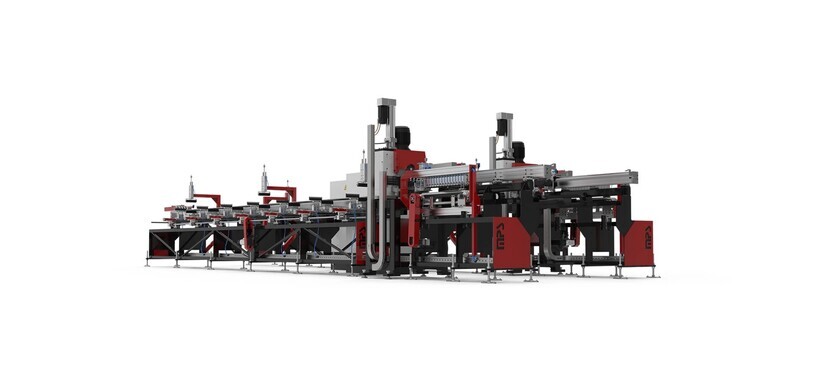
Van Dulst developed a robot system that stands ready while the saw is still in the material. As soon as the saw is clear, the robot grabs the products and the saw can immediately start the next cycle. While the saw is working again, the products are blown clean and transferred to the next station.
This doesn't make the sawing machine faster, but daily output does increase because the machine keeps running during breaks. Because the system was first fully built and tested at Van Dulst, downtime at the customer's site was limited to one week.
Curious how this could work for you?
Van Dulst is happy to help you think through expanding your production, from the initial exploration to an installation that's up and running within a week. Get in touch with us for a no-obligation consultation.


