 07 October 2026Automating with a robot, without weeks of lost productionReading time 3 minutes
 18 September 2026Flexibility vs. speed: the hidden trade-off behind every production lineReading time 4 minutes
 10 September 2026How software turns every centimeter of aluminum into valueReading time 1 Minute

Laser, inkjet or label: how do you mark aluminium profiles?
A beautiful door, deep black with a sleek finish. On the inside there's a bright yellow sticker with red text, containing maintenance information. Functionally, a sticker like that works fine, but it isn't pretty. You see it more often than you'd think: a carefully designed product, spoiled by the way information has been applied to it.
This touches on a question more and more manufacturers are grappling with. How do you put information on your product without detracting from it?
Why marking is becoming increasingly important
Many component manufacturers are invisible. Their profiles end up in doors, window frames, machines or buildings, but the end user has no idea who made them. A marking on the product changes that. Such a marking can do two things:
- Branding: with a logo on the product, your name gradually becomes associated with what you make. Anyone who needs the product later knows where to go.
- Traceability: a QR code or serial number tells you exactly which product it is. If a component gets damaged, someone scans the code and immediately knows what needs to be replaced.
The question then is which marking method suits that best.
Alprokon as a case study
Alprokon has been making aluminium door edge profiles for forty years: the profiles that close swing doors against each other in hospitals and public buildings, often fitted with a fire-resistant or draught-proof strip. The products keep innovating, but outside the industry hardly anyone knows the name. Alprokon wants to change that.
Alprokon initially marked its products by hand and ran its own trials with different methods. Because the company wanted to take its branding seriously, it chose to automate with laser marking. Van Dulst supplied a laser marking system that applies a logo, a QR code and, where needed, an additional code to every door edge profile.
The process is simple for the operator. He scans the profile with a barcode reader and places it in an automatic infeed magazine. From there, everything runs by itself. The Van Dulst control system retrieves the correct coding from an Alprokon file and sends it to the laser source. The profile is fed past the laser, marked and discharged. The system processes around 150 profiles per hour, easily keeping up with the upstream machining equipment.
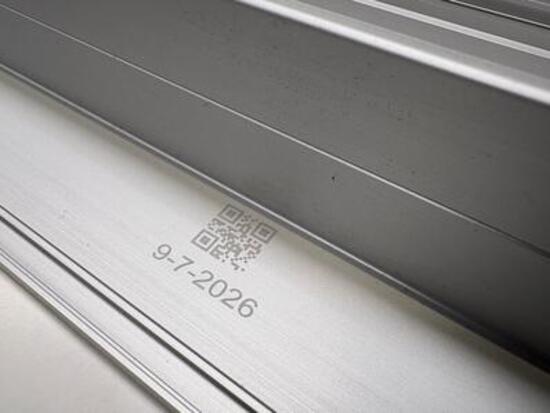
The result is a marking that is clearly visible yet unobtrusive. It simply looks classy, which is exactly what you want when your product is your calling card.

Four options side by side
The sticker is the easiest solution. It's quick to apply and requires very little. But a sticker can peel off or get damaged, and it often doesn't match the look of the product.
Inkjet prints the information directly onto the surface. That looks neater than a sticker, but the ink sits on top of the material. Through wear, cleaning or prolonged exposure to light, the marking can fade or be wiped away.
In addition, black ink is usually used, which is barely visible on black or grey coated material. In aluminium window and door frame manufacturing, where dark coatings are common, that is a significant drawback.
Switching ink colours is possible, but quickly makes the solution relatively expensive.

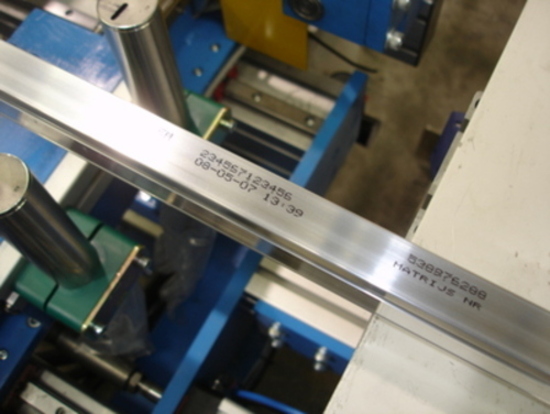
A laser works differently: it removes a very thin layer of material from the surface. As a result, the marking isn't on the aluminium, but in the aluminium. It's indelible and remains legible for the product's entire lifetime. A laser can also work with great precision: a complete QR code of 15 by 15 millimetres is no problem.
The laser does mark a limited area of the profile, and usually works at a fixed focal distance. On the other hand, it is exceptionally fast and can even mark through the paint layer. You also have complete design freedom: logos, custom fonts, QR codes and other geometry are all possible.
Besides laser engraving, there is also the option of engraving with a pneumatic dot peen marker. A pin strikes the material at high frequency, creating small dots that together form the code or text.
The big advantage is that the marking remains legible even after a layer of paint has been applied over it later. The engraving depth is often adjustable via the impact force, so you can tailor it to the material and any finishing processes.
One drawback is the relatively long cycle time, which makes this method mainly suitable for short codes.

Getting started with marking?
If you're thinking about marking your products, start by asking what the marking needs to do. Is it about brand awareness, traceability, or both? How long does it need to last, and how visible should it be? Van Dulst is happy to help you think it through, from choosing the right method to a fully automated system that connects to your own data.


questions? 0180 510 455

Remove product from quotation list?
Are you sure you want to remove this item from your quotation list?