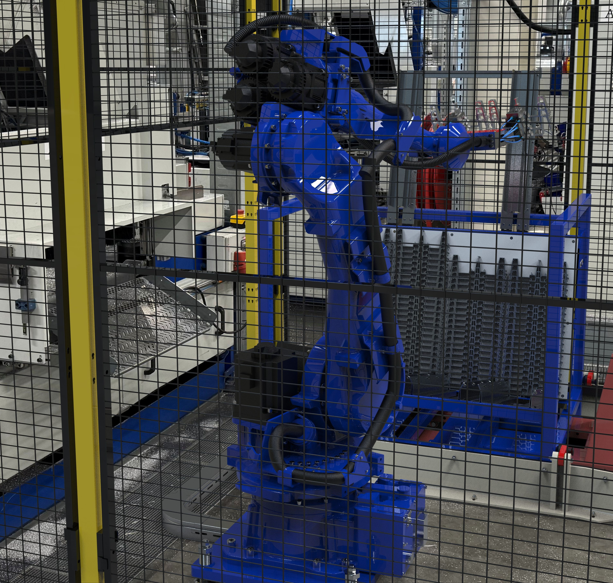
Robotic unloading system added to a sawing machine
A long-standing customer of Van Dulst Techniek, operating in the aluminium processing industry, had a clear wish: the manual unloading of products after sawing needed to be automated with a robot. The Van Dulst Techniek sawing machine was already in place and performing well, but a lot of manual work was still required around the machine.
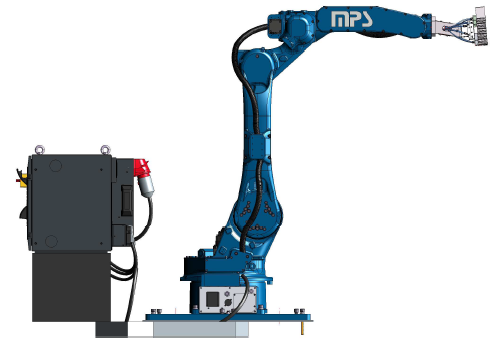
Through MPS (Modular Production Systems), Van Dulst Techniek developed a robotic unloading system that connects directly to the existing sawing machine. The result: a sawing process that can run largely unmanned, with around 90% of the manual work eliminated.
The challenge
After sawing, the products were unloaded by hand, for example from a conveyor belt, and carried manually to the next station. This is repetitive, labour-intensive work that required an operator to be permanently present at the machine.
The customer wanted to organise the unloading of products after sawing more efficiently. The manual work around the machine was a constant drain on capacity, while repetitive tasks like these are ideally suited to automation. Van Dulst Techniek came up with a solution: extend the existing sawing machine with a robot that takes over the unloading completely. After all, the sawing machine runs on Van Dulst Techniek's own control system, and a robot that has to work seamlessly with that system calls for a partner who knows the machine inside out.
On top of that, there was no off-the-shelf solution for this application. The robot had to intervene directly in the sawing process, at exactly the right moment, without disrupting the sawing cycle.
Our solution
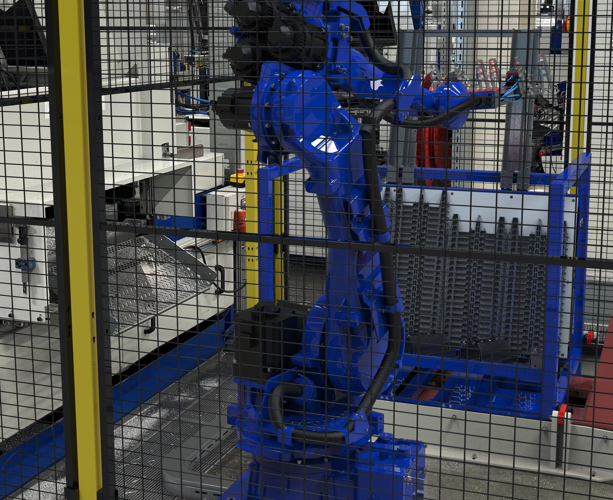
Van Dulst Techniek developed a robotic unloading system that is fully tailored to the existing sawing machine. While the saw is still cutting, the robot arm is already standing by. As soon as the saw has cleared the material, the robot removes the products, after which the saw can start the next cycle straight away.
Seamless integration with the existing control system
Because both the sawing machine and its control system were built by Van Dulst Techniek, the robot could be linked directly to the existing machine control. Machine, control system and robotic automation therefore all come from a single source. This avoids coordination issues between different suppliers and ensures that the robot and the saw work together as one unit.
Cleaning and transfer within the same cycle
While the saw carries on working, the unloaded products are blown clean and taken to the next station. These steps take place within the sawing machine's cycle, so no additional waiting time is created.
Investigate first, then build
As this was a truly bespoke project, Van Dulst Techniek proposed setting it up in two phases. The first phase was an engineering assignment in which the critical elements were tested and mapped out, such as the type of gripper, the required gripping force and a simulation of the robot movements. In the second phase, the project could be carried out based on the outcomes of the engineering assignment.
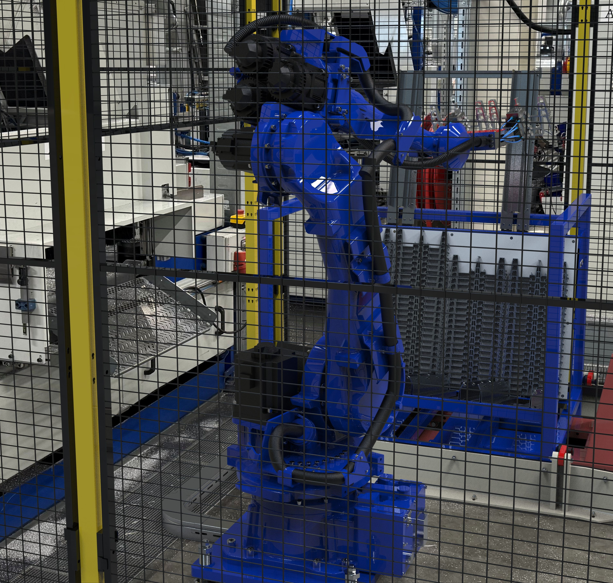
How the process works in practice
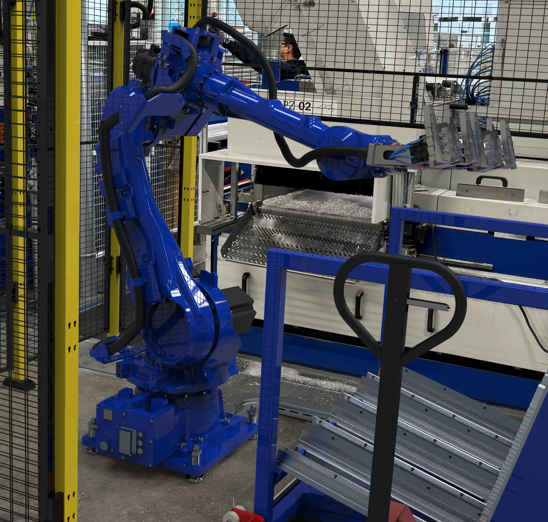
- The sawing machine cuts the material while the robot arm is already standing by.
- As soon as the saw has cleared the material, the robot removes the products.
- The saw immediately starts the next sawing cycle.
- In the meantime, the products are blown clean.
- The robot takes the products to the next station.
This eliminates the manual unloading and moving of products, which previously demanded an operator's full attention. The machine does not run any faster as a result, but it does run largely unmanned.
Suited to the customer's production situation
Continuity was the top priority for this customer. The sawing machine is an integral part of production, and prolonged downtime was not an option. That is why Van Dulst Techniek first builds and tests the complete set-up in its own workshop. Only once everything runs smoothly is the system delivered to the customer, where implementation takes place within a week.
The customer has been working with Van Dulst Techniek machines for many years. This extension shows that an existing machine does not need to be replaced in order to take a major step forward in automation. By building smartly on what is already in place, most of the manual work is eliminated without turning existing production upside down.
Would you also like less manual work around your machines?
Is there still an operator standing at your sawing or processing machine to unload and move products? Or would you like to know whether an existing machine can be extended with robotic automation?
Van Dulst Techniek is happy to think along with you, from the initial feasibility study to a fully delivered robotic solution.
Get in touch for an advisory meeting. Together, we will look at your production process, your existing machines and the opportunities for automation.
0180 510 455
verkoop@vandulst.nl


